Vies & Analysis
-
September 6, 2022
Why Invest in a Venture Capital Fund-Of-Fund
TL; DR;
Key Findings
The analysis below distills some of the key findings apparent in both academic and industry studies on VC, notably:
a series of papers written by University of Chicago’s Steven Kaplan (together with other academics at Wharton and Oxford), based on data from more than 1,400 VC funds, with vintages starting in 1984 (‘the Kaplan studies’)[1] , and;
industry reports and analysis from Cambridge Associates (‘CA’), the industry reference for VC fund performance, which has surveyed more than 2,000 VC funds since 1995.
Our key findings can be summarised across the following four areas:
Performance – Venture funds have beaten the public markets consistently.
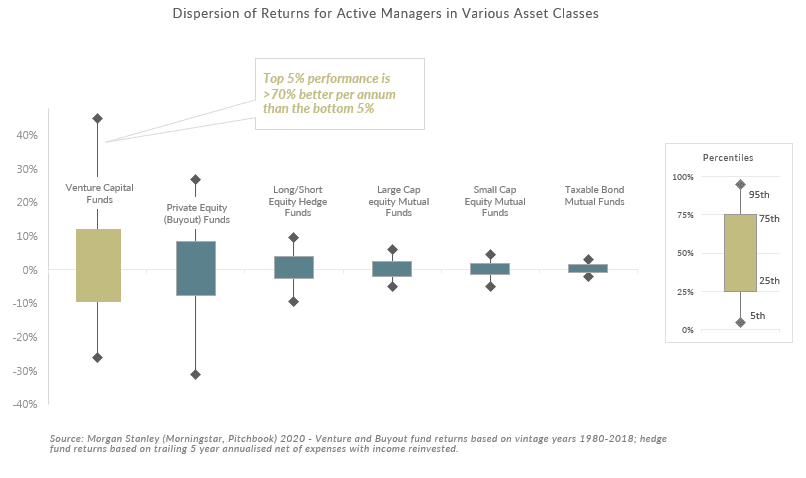
Dispersion – The best Venture funds perform extraordinarily well, but the rest don’t. In other words, if you don’t invest with the best Venture funds, you’ll probably underperform the market.
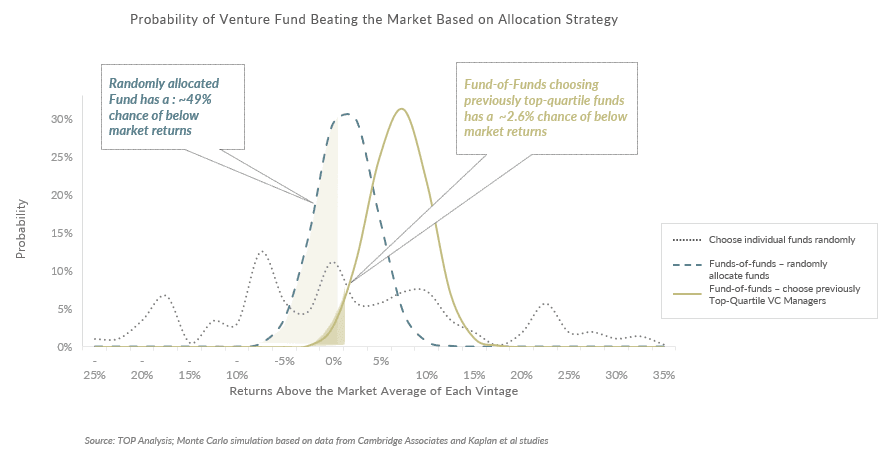
Persistence – The best Venture funds have a high probability of continuing to be the best. The best VC funds are difficult to access (scarcity), but accessing them is a winning strategy.
Concentrated Diversification – Even the best Venture funds can have weaker vintages given the idiosyncratic nature of venture…or just because they find themselves overpaying during boom cycles. Diversification across vintages and a core set of managers (combined with industry-insider knowledge) is a tangible benefit that a Venture Capital fund-of-funds (FoF) can deliver.
Performance
Venture capital funds have consistently outperformance the markets.
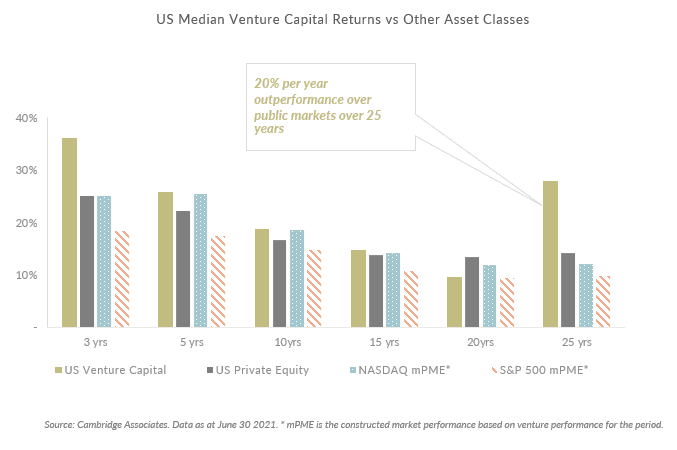
The chart below shows the performance of Venture Capital (VC) funds over various periods versus a public market benchmark (mPME).[2] As we can see, overall, VC funds have beaten the public markets quite consistently. However, the average data belies a deeper truth which is that average VC (out)performance is driven by a very small subset of Venture funds – namely the top-quartile of managers.
Dispersion
The best venture capital funds have outperformed the markets by a lot.
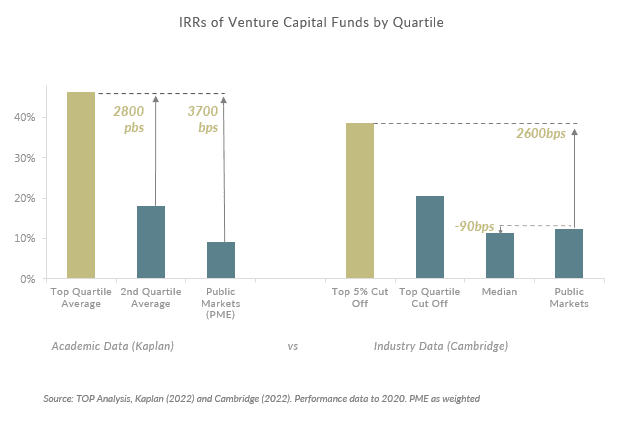
Indeed, both academic and industry data indicate that Venture funds demonstrate particularly high dispersion – that is: the difference between the best performing VC funds and the rest is enormous.
For example, the Kaplan studies show that top-quartile Venture managers generated a 46% IRR – that is, 2,800bps better than the average of the 2nd quartile managers, and 3,700bps better (or 5x higher) than the public comparable. Similarly, the CA data shows that top-quartile and top-5% VC funds outperformed public markets annually by at least 800bps, and 2,600bps respectively, where median VC funds underperformed by around 90bps.
Concentrated Diversification
Conclusion
Author(s):
References:
[1] Main academic sources of data are papers written by Steven Kaplan from the University of Chicago together with colleagues from Oxford (Said) and Virginia (Darden), notably: Harris R., Jenkinson T, Kaplan S. and Stucke R. Has Persistence Persisted in Private Equity? Evidence from Buyout and Venture Capital Funds, SSRN id2304808, March 2022 (‘the Kaplan studies’ or ‘Kaplan et al.’).
[2] The PME (or mPME) is constructed based on the underlying public market index as adjusted to reflect the cashflows and compounding effects of a closed-end structure.
Disclaimer
THIS ARTICLE CONSTITUTES AN UNOFFICIAL SUPPORT OF THE TECHNOLOGY OPPORTUNITY PARTNERS family of funds (HEREINAFTER THE “FUNDS”).
The content of this article has been approved and issued by TOP Venture SA (hereinafter “TOP”) for information purposes only. The information and opinions contained in this article are for background information and discussion purposes only and do not purport to be full or complete. No information in this article should be construed as providing financial, investment or other professional advice. This information contained herein is for the sole use of its intended recipient and may not be copied or otherwise distributed or published without TOP's express consent. No reliance may be placed for any purpose on the information contained in this article or their accuracy or completeness. Information included in this article is intended for those investors who meet the Qualified Investors definition of the Collective Investment Schemes Act of 23 June 2006 and its ordinance and the Financial Conduct Authority definition of Professional Client or Eligible Counterparty.
Confidentiality
This information contained herein is confidential. Each copy of this article is addressed to a specifically named recipient and shall not be passed on to a third party. By its acceptance hereof, the recipient agrees to keep the article and its contents strictly confidential and may not disclose or divulge any information contained herein to any other person. This article and its contents cannot be published, copied, reproduced or distributed in any manner whatsoever. The recipient will use this article for the sole purpose of obtaining a general understanding of the business, operations and financial performance of TOP in order to make a decision as to whether the recipient should proceed with a further investigation of the Funds and this investment opportunity. TOP reserves the right to request the return of the information presentation herein at any time, without the retention of any copies by the prospective investor.
Investment Risks
The value of all investments and the income derived there from can fluctuate due to market movements and you may not get back the amount originally invested. In the case of overseas investments, values may vary as a result of changes in currency exchange rates. This may be due, in part, to exchange rate fluctuations in investments that have an exposure to currencies other than the base currency of the portfolio. Past performance is no guide to or guarantee of future performance.
Limitation of Liability and Indemnity
TOP expressly disclaims liability for errors or omissions in the information and data contained in this article. No representation or warranty of any kind, implied, expressed or statutory, is given in conjunction with the information and data. TOP accepts no liability for any loss or damage arising out of the use or misuse of or reliance on the information provided including, without limitation, any loss of profits or any other damage, direct or consequential.
You agree to indemnify and hold harmless TOP and its affiliates, and the directors and employees of TOP and its affiliates from and against any and all liabilities, claims, damages, losses or expenses, including legal fees and expenses arising out of your access to or use of the information in this presentation, save to the extent that such losses may not be excluded pursuant to applicable law or regulation.
Any opinions contained in this presentation may be changed after issue at any time without notice.