February 11, 2026
Chronicle of an Exit Foretold
Of trust and conviction in the venture business
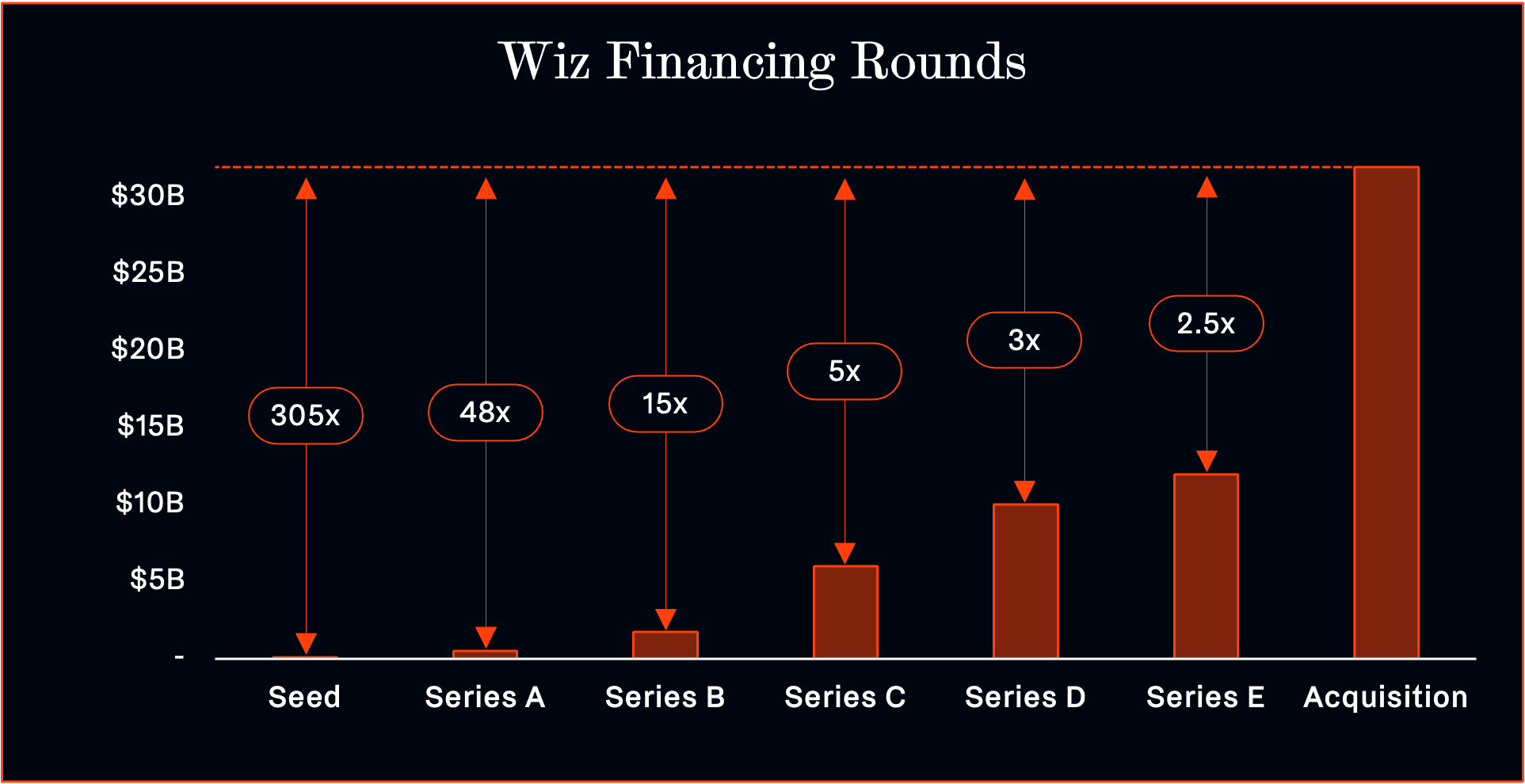
In 2025, Google announced that it would acquire Wiz for $32B. This transaction represents the largest acquisition of a venture backed company ever, and what’s more, it happened in record time – only 5 years after the company was founded. Index Ventures, one of the early backers of Wiz is estimated to have turned the $43.5M early-stage investments it made in 2020 into $3B!!! … a 70x return in 5 years, or a 120% IRR.* The seed round by itself would have generated around 300x for Index, Cyberstarts and Sequoia, the early backers of the Company.
Given these returns, aspects of Wiz’s journey are worth recounting as they bring out the defining characteristics of the venture business, including those of TOP Venture.
* The IRR assumes a Q1 2026 realization. Also note that of course, Index also made some later round investments in Wiz, with lower risks and returns. Those are not included in the numbers mentioned.
Let’s start 8 years before Wiz was even created. In 2012, a McKinsey Tel-Aviv consultant called Assaf Rappaport founded a company called Adallom to help enterprises protect their data in cloud environments. Adallom attracted venture funding from Gili Ranaan, then a partner at Sequoia, and Shardul Shah, a young principal at Index Ventures. Within 3 years, Microsoft bought the company for $320M. Although Adallom never became a household name, it is still considered a successful venture investment, and a great acquisition for Microsoft. Adallom became a cornerstone of Microsoft’s cloud security business, now estimated to generate some $20B in revenues.
More importantly for our story though, Adallom helped forge a bond of trust between Gili, Assaf and Shardul; such that, 8 years later, when Assaf left Microsoft to found Wiz, he wouldn’t have to think twice before approaching his previous backers to help fund his new gig: Gili who had since founded his own venture fund called Cyberstarts, Shardul who had been promoted to partner at Index, and Doug Leone, the managing partner of Sequoia (who had worked together with Gili on the Adallom investment team).
Many people imagine that the job of a venture capitalists is to wait for promising startups to parade in front of them, as they decide yay or nay; then cut cheques and sit back and wait for the start-up to get acquired for billions. The reality is that success in the venture capital world is often built on a history of well-earned battle scars, or to quote Teddy Roosevelt, by “the man[!] who is actually in the arena, whose face is marred by dust and sweat and blood;” In venture, that sweat and blood often comes from the previous deals that the VC has worked on – the experience gained from previous successes, as well as failed investments, and the networks built as a result. Oftentimes, the greatest venture successes are founded by ex-employees of companies that had been previously backed by the same VC. This is a win-win for all. The VC knows how this new founder operates from their previous ventures and has gotten to know and trust them as a person, understanding their values, their integrity, their capabilities, as well as their grit & commitment to deliver on their promises. Even if they had not previously worked together directly, the new founder might have been referenced by their boss or boss’s boss to the VC, transferring that bond of trust through this network. Similarly, the founder will have also taken away key lessons from the previous startup and seen how success can be built, how new markets can be created, how growth can be managed, how a successful company culture can be built. The VC too would have greater confidence that the new founder knows what (s)he is getting into. The two share a common frame of reference, helping the VC gain Conviction on the opportunity and the entrepreneur’s ability to execute on it.
In the venture world Conviction is key. Locking in the financing helps of course, but in practice - for the best entrepreneurs – money has increasingly become a commodity. The best entrepreneurs often have access to multiple sources of capital, and they get to choose which VC to partner with. For this, the VC’s Conviction in the opportunity becomes critical. This Conviction creates impetus for the VCs to help the startup as much as possible, leveraging their rolodex to call on executives at companies that might become customers of the startup, or convince these same execs to join the company. The Conviction will also convince the other partners at the firm to do the same - working together and doing their utmost to make the start-up a success, prioritizing it over others in the portfolio.
Wiz’s first rounds of funding give a good idea of its VC partners’ Conviction. The Seed round, completed in early 2020, valued the company at $70M, which is not unusual given the pedigree of the founders. More tellingly, the same investors led a Series A round at a $500M valuation later that same year! The company was worth half a billion in year ONE! This datapoint clearly indicates the enormous Conviction Wiz’s venture backers had from the outset.
As noted above, the valuation is not the end in itself, but a signal of Conviction, and that signal provides the means to build momentum towards success. The available liquidity from the financing rounds signals to potential employees and customers that Wiz is onto great things and entices them to become part of the journey. The high valuations achieved allow the founders to raise the capital required (while holding on to a material stake in their company) to build a dominant product with a best-in-class sales and marketing effort right out of the gates. Fortune 100 CIO’s are probably the toughest buyers in the world. The bar is very high for them to be convinced to entrust their security to a de-novo provider, rather than large incumbents with whom they already have relationships, and who would be doing all they could to dissuade their customers to give business to a new startup. As such, the valuation of Wiz, the quality of the team, the quality of the product, and the Conviction of the VCs would all work to reinforce the company’s ability to deliver superior performance.
Within this context, given their Conviction, Shardul, Gili, and Doug would do all they could to help the Wiz team achieve its goals. Gili had built one of the strongest networks of company CIOs over the 10 years he had spent at Sequoia, and he wouldn’t shy away from calling on them to be early customers of Wiz. Similarly, Doug Leone (Sequoia) and Shardul Shah (Index) could call on execs at some of the most successful enterprise companies, thereby building a strong enterprise network and credibility in the process. These GP’s rolodexes were not strong because they exchanged cards at some conference dinner – they were powerful because they were built over years of business dealings. Successful outcomes in the venture world strengthen the firm's credibility and network, making it much easier to persuade people in their network to bet on a startup recommended by a proven VC partner. This ability to supercharge a founder in their mission to build a category-defining business is what attracts the best entrepreneurs to the best VCs.
Of course, the success of Wiz can only be attributed to Assaf and his team, but the venture capitalists’ network can be critical in convincing that one amazing CXO to join a company or that one Fortune 100 CIO to take a bet on a startup’s new product. The trust and conviction between entrepreneurs and VCs can create a powerful virtuous cycle – a flywheel of success that reinforces itself over time. This is why we believe that top-tier venture capital funds, if run well, are in the best position to benefit from subsequent waves of innovations, attracting the best entrepreneurs, uncovering the highest potential opportunities, and playing a role in converting those opportunities into world-beating companies. This dynamic is a key reason that the data shows strong persistence of performance in proven venture capital managers.
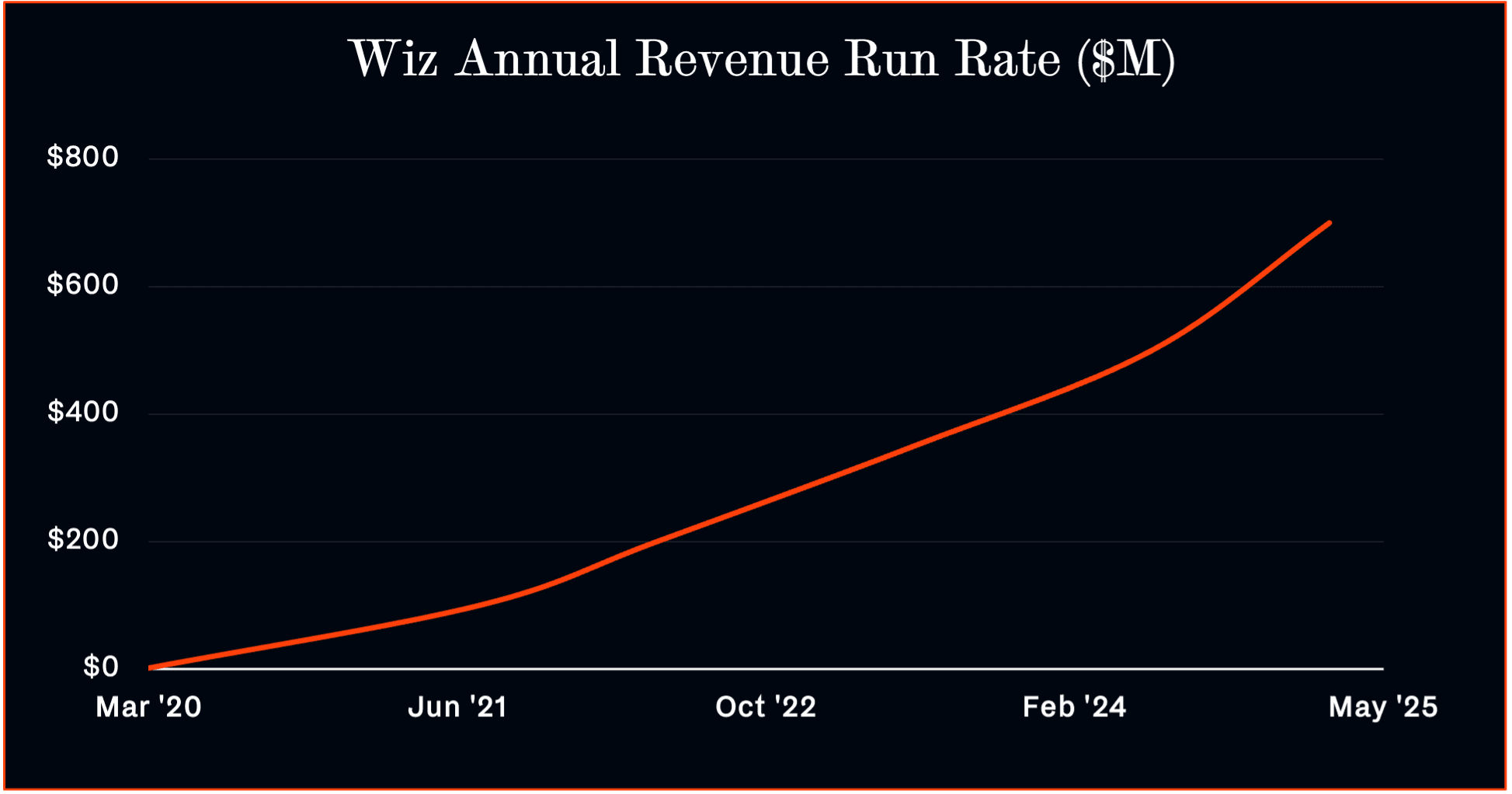
Wiz thus became the fastest company ever to reach a $100M run rate, 18 months after founding, and it reached $200M only nine months later. This growth rate prompted the Series C round, which closed at $6B (or 3x the Series B) in October 2021. This is about when Wiz showed up on TOP Venture’s radar, and by February 2023, when the company raised a Series D at $10B, Wiz was top of our list. Just like in 2020, when Assaf (CEO of Wiz) called Shardul (Index) to tell him that he had decided to launch Wiz, and Shardul asked ‘How Much?’ (because Shardul had all the Conviction he needed given his history with Assaf) – we at TOP-Venture were ready to pounce at the Series E because we had been tracking the company throughout its scale-up, triangulating within our network of trust for the insider’s view of the company, and building Conviction. Despite paying ~30x the Company’s revenue run-rate – we were confident that Wiz had hit escape velocity…and that it wouldn’t be long before the market would figure it out. Less than one year later, Wiz agreed to be acquired by Google for $32B in cash (with the final transaction pending regulatory reviews and approvals). Meanwhile, Wiz’s run rate continues to grow and it is further consolidating its position as a leader in the market.
Today, the $10B valuation looks like a bargain. None of the deals we do in our TOP-Direct family of funds ever seem cheap at the time the deal gets done - that’s because these era-defining companies are on growth trajectories for which there are no comparables. These n-of-1 companies are forging a path and defining new markets that have not existed before. Like surfers who are paddling in the waters observing how the waves are being formed and positioning themselves to catch the next big one in the set, later stage tech investors need to figure out which start-ups are best positioned to exploit the next tech sea change. Successful VC investors leverage the intuitions they have gathered from their hard-earned experience; they hustle to extract insights from the networks of trust they have built; and then they hope for a little luck as they paddle furiously to catch the wave they have committed to ride.
When a startup is first founded, these waves are barely discernible, and seemingly small agitations in the seas can evolve into ginormous waves. Early-stage tech investors need to recognize great founders from the start, and their potential to realize the opportunities they have identified… and then hustle to win the founders over, so they can partner with each other via a financing round. After the initial investment, the VC’s role ranges from being a shoulder to cry on during hard times (and all companies go though some hard times), to being a sounding board for key decisions on strategy, especially in areas such as GTM, scaling, M&A, and IPOs; and then keep hustling, not only to help hire new employees and introduce customers to the company, but to sense the critical changes in the market that could either annihilate the company’s initial business assumptions or magnify the opportunity space they are playing in - in each case helping the company anticipate and navigate these changes. Our TOP-VC family of funds aim to identify VC’s who are best positioned to do all of this and more, thus creating those virtuous cycles of Conviction, Trust and Value Creation that make every successful deal feel like its destiny had been foretold from the day it was founded.
Author:
Disclaimer
The content of this article has been approved and issued by TOP Venture SA for information purposes only and does not purport to be full or complete. All numbers in this article have been calculated from public sources of data, including this article. The information and opinions contained in this document are for background information and discussion purposes only and do not purport to be full or complete. No information in this document should be construed as providing financial, investment or other professional advice.